 |
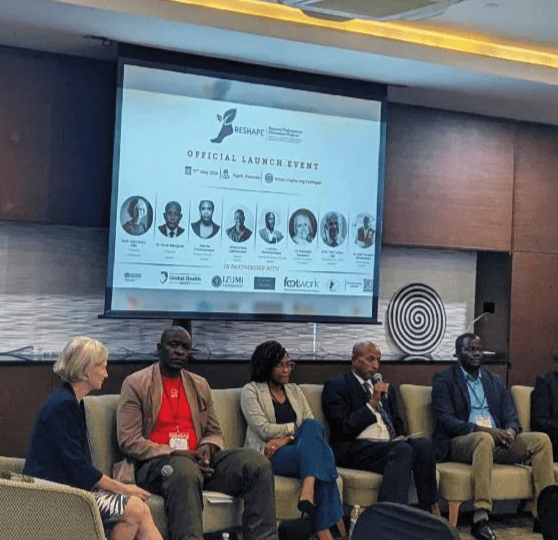
Professor Gail Davey, far left, at the official launch of RESHAPE |
|
A new regional platform to support Africa’s fight against podoconiosis, a neglected tropical disease, has been launched in Kigali, marking the latest step in Professor Gail Davey’s decades-long work to eliminate the condition.
RESHAPE: Resilient and Sustainable Health Systems Approaches to Podoconiosis Elimination, launched on 19 May, brings together researchers, health experts, government officials and former patients to help countries identify cases, improve treatment, train healthcare workers and share knowledge. |
|
|
University of Sussex global health expert Professor Davey OBE, founder of Footwork, worked with researchers at Brighton and Sussex Medical School to launch the new platform in partnership with the University of Global Health Equity and regional health institutions.
The condition causes severe swelling of the legs and feet and can lead to disability, stigma and exclusion. Unlike many tropical diseases, it is not caused by a virus, bacteria or parasite, but develops after long-term exposure to irritant red clay soils in tropical highland regions, particularly among people who work barefoot.
Through her research and advocacy, Professor Davey has helped bring podoconiosis from the margins of health policy into national and regional activity.
Professor Davey said RESHAPE is developing “a network across the WHO Afro region to underpin podoconiosis elimination”, marking what she describes as “an important translational step that builds on two decades of research into this highly neglected condition.” |
|
|
Breaking down barriers between the public and science |
|
|
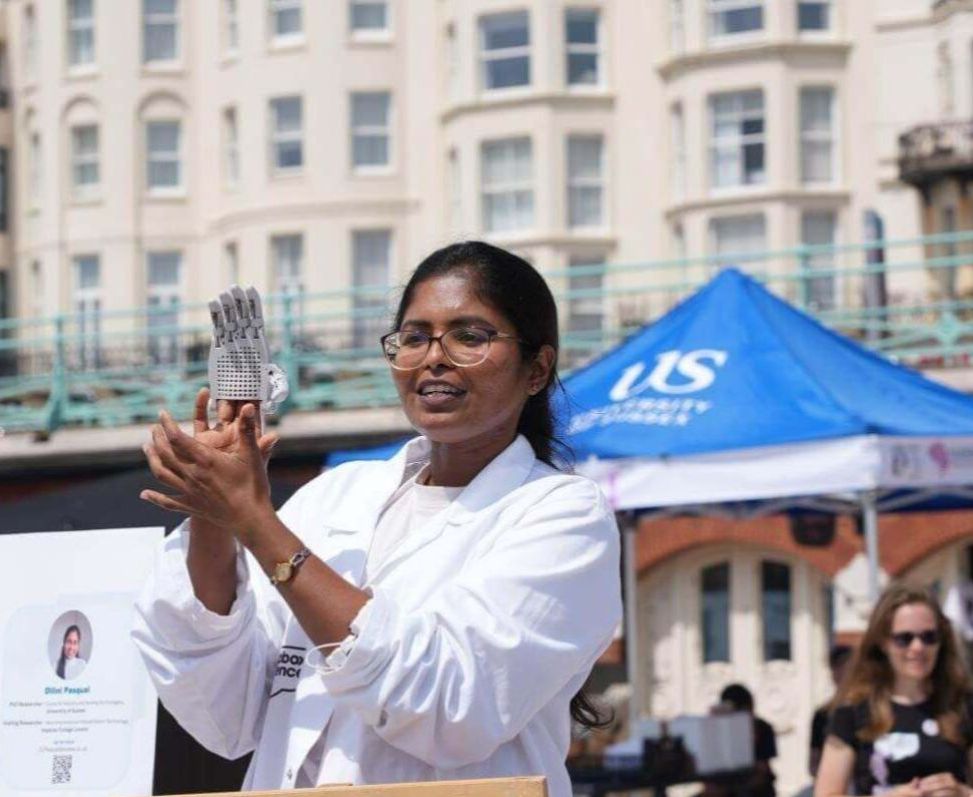 |
Doctoral Researcher Dilini Pasqual (Engineering and Informatics) |
|
Brighton seafront became an open-air arena for public learning and scientific debate last weekend (30 May) as Soapbox Science returned to the city for its ninth year.
Part of a global initiative celebrating women and non-binary researchers working across science, technology, engineering, mathematics and medicine (STEMM), the event brings speakers into public spaces to share their latest discoveries with local communities. |
|
|
Led by a team at the University of Sussex, Brighton's Soapbox Science events began in 2017 and are now part of the Brighton Festival, for which Sussex is the official Higher Education Partner.
On the day, researchers from Sussex and UCL explored a wide range of topics, from how babies perceive colours and shapes, to whether AI can learn to see like us, the future of wearable robotics and new diagnostic imaging tools for cancer.
Event lead Dr Laura Blackburn said: Soapbox Science is about “breaking down barriers between the public and science, and challenging outdated ideas about who can be a scientist”. |
|
|
Comment: Why research must feed into government migration policies |
|
|
By Michael Collyer
It is a debate that appears to go around in circles. Migrant workers can support economic growth and public services, but rapid population change can also place huge pressures on infrastructure.
The challenge for governments is in developing informed policies that address the impacts of migration, reinforce its benefits, and achieve strategic goals related to development, security, and international stability. |
|
|
As a newly appointed advisor to the government’s Foreign, Commonwealth and Development Office (FCDO), and in my capacity as Professor of [human] Geography at Sussex, I will be helping to ensure that migration policies are informed by relevant existing evidence and identifying gaps that may be filled by new research.
The FCDO has listed 18 questions on migration in their current Areas of Research Interest (ARI), including: “What impact do safe and legal migration routes have on irregular migration to the UK?” and “What is the role of illicit economies and organised crime in driving and facilitating migration?”.
I have views on all of the 18 migration-related questions in the new ARI document. Yet pinpointing sources of evidence, articulating them in clear, concise ways and trying to convince a well-informed, sometimes sceptical audience is always harder than I expect.
The view that research can and should improve policy animates many of us conducting research into migration issues. It is a real privilege to be trying to connect research and policy from inside such a significant institution. And the FCDO is open to this.
Despite recent cuts, the FCDO is still a major research funder. Very few funders are willing to support research over the long term, but many FCDO-funded centres -including some outside the UK and with colleagues in the Global South - have run for over a decade and have the flexibility to respond to the changing political environment.
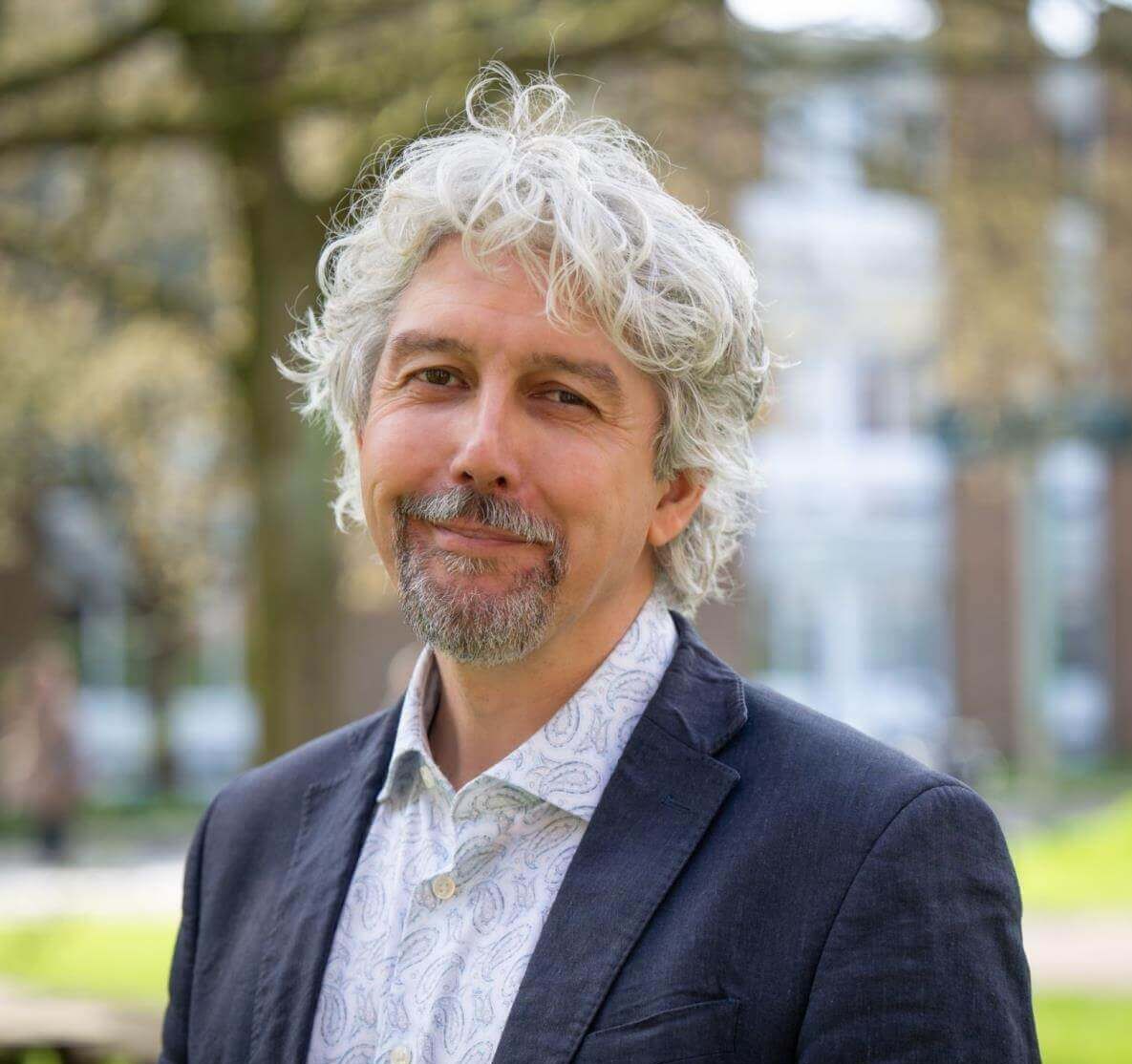
Professor Michael Collyer is Head of Geography at Sussex and Senior Research Fellow (Migration) to the government’s Foreign, Commonwealth and Development Office (FCDO). |
|
|