This email looks better with images enabled.
|
|
|
|
Harborough District Communities News
| May 2026 - focus on volunteering for Volunteers' Week
The aim of this newsletter from Harborough District Council (HDC) Community Engagement Team is to keep you informed and up to date with community development activities at the council and elsewhere and to share information, resources and success stories between you to support communities, build networks and relationships, and share ideas and good practice.
This month we have a focus on volunteering before Volunteers' Week, 1-7 June 2026. We'll keep you informed about any upcoming events inside and outside the council. Let us know if you've got anything to share.
Please share this newsletter with relevant colleagues, they can sign up below. |
|
|
|
The Community Engagement Team
Opportunities to get involved in community action
Grants
Around the district - celebrating the role of volunteers for Volunteers' Week
Young people
Consultations
Getting support |
|
|
|
The team have been busy out in the community and recently working at different polling stations across Market Haborough for the Community Governance Review, which included a poll asking residents whether they want Market Harborough to have a town council.
Claire Betts and Serretta Morris, Grants Officers, have been busy with applications for round three Community Grant which closed earlier this month, processing the applications and compiling reports ready for councillors' decisions. |
|
|
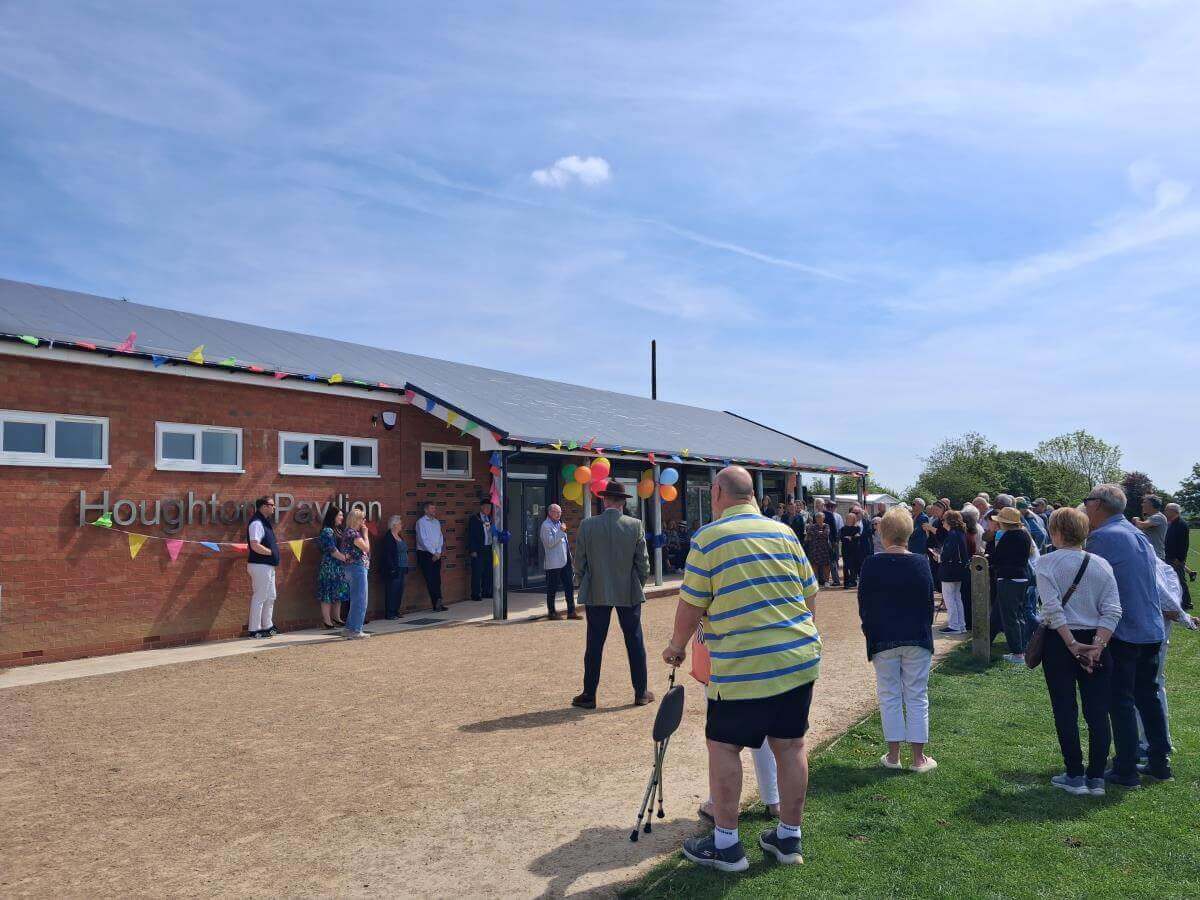
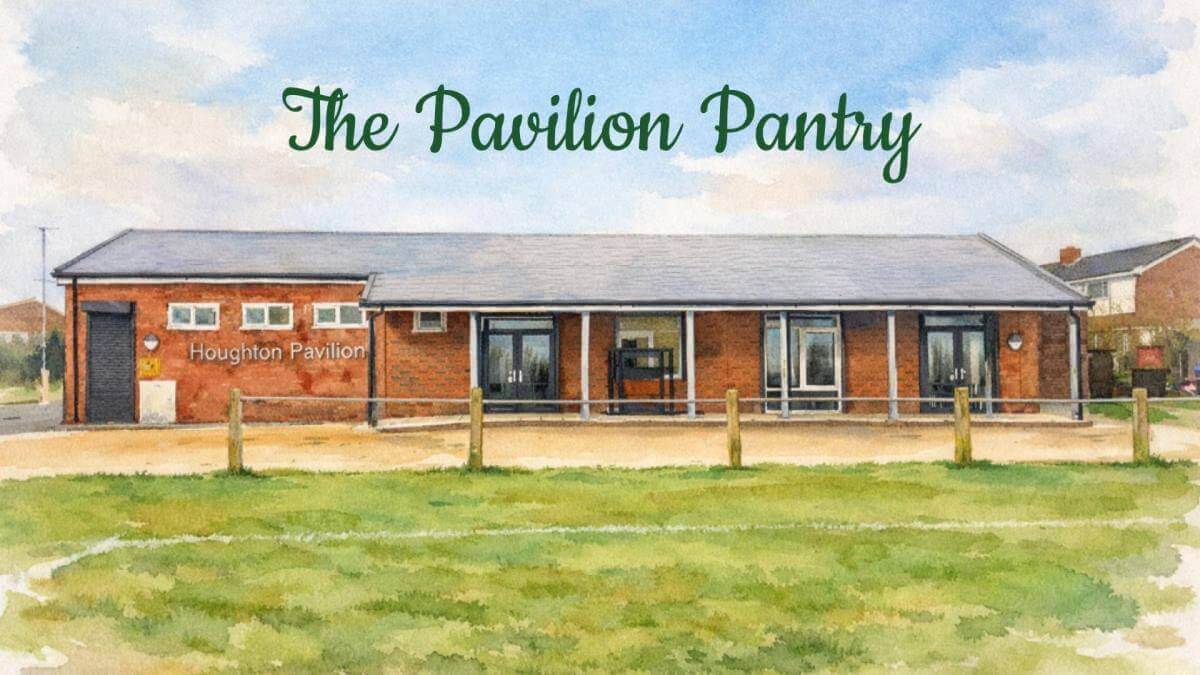
Gemma Finan, Community Development Officer attended the grand opening of the Houghton Pavilion (see picture above). This is the venue for their new Pavillion Pantry, hosting the local foodbank and community cafe. Gemma has been working with them to understand more about the needs and gaps in the local area and to develop further links between Harborough District Council and community groups. She's keen to understand and develop support in areas where there is currently very little, particularly the rural east of the district.
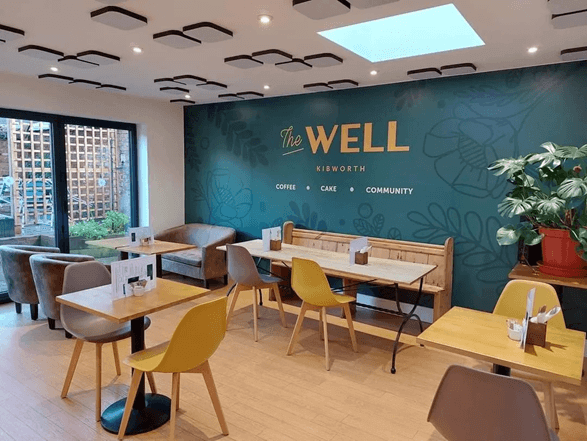
The team hosted a work experience student from Lutterworth College, and she accompanied Gemma and Becky Nixon, Community Engagement Team Manager, on a trip to The Well in Kibworth (pictured below), where manager Andy Wright, talked about the history of the organisation and the services it provides now. Becca Powell, Youth Engagement Officer, spent time with the student looking at a communications plan for the Youth Council, particularly around launching the new logo. |
|
|
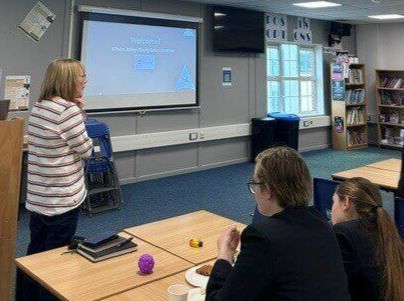
Becca also visited Market Harborough Building Society to speak to young people from Kibworth Mead who are spending the week there for work experience, taking part in lots of different workshops. Becca spoke to the young people about the Youth Council and the Young People’s strategy that is currently being revised. It was a great opportunity to consult a wider range of young people on the issues the Youth Council have identified, read more below.
|
|
|
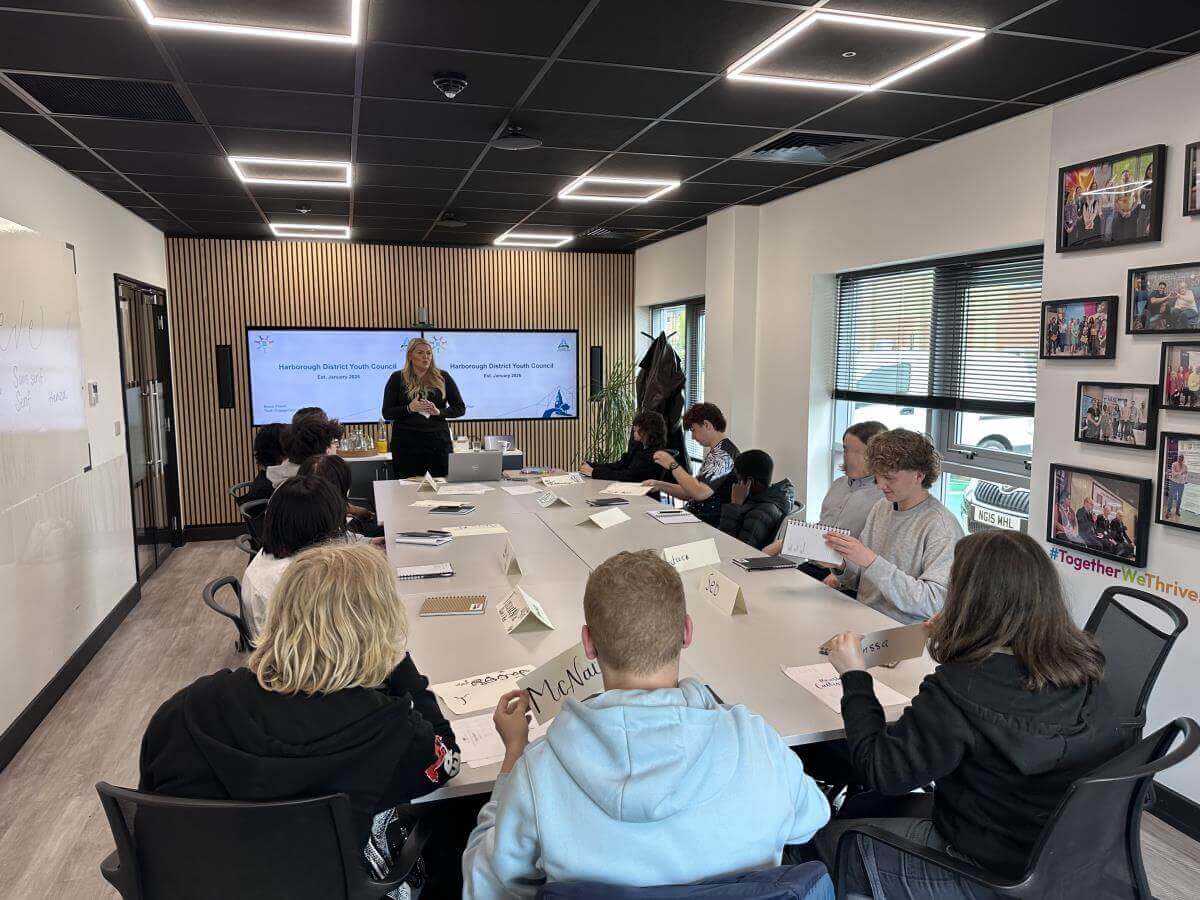
Becca hosted May’s Youth Council meeting in Lutterworth, which you can read more about below.
Gemma and Becky Nixon, Community Engagement Manager, are continuing to work with Citizens Advice LeicesterShire and other groups across the district on a project to create a network of support across the district, particularly in rural areas, so residents are better able to get help where they are. This fits with the wider aims of the national Crisis and Resilience Fund, and we are hoping that the work that we've already done will help to shape how this is delivered in Leicestershire, particularly ensuring reach into the smaller villages where there is little provision, and using the framework that we've developed to ensure that organisations supporting residents are doing so within their capabilities and know where to get further support. We're still keen to talk to parishes and other groups to build up evidence for funding applications.
|
|
|
Our new communities webpages |
|
|
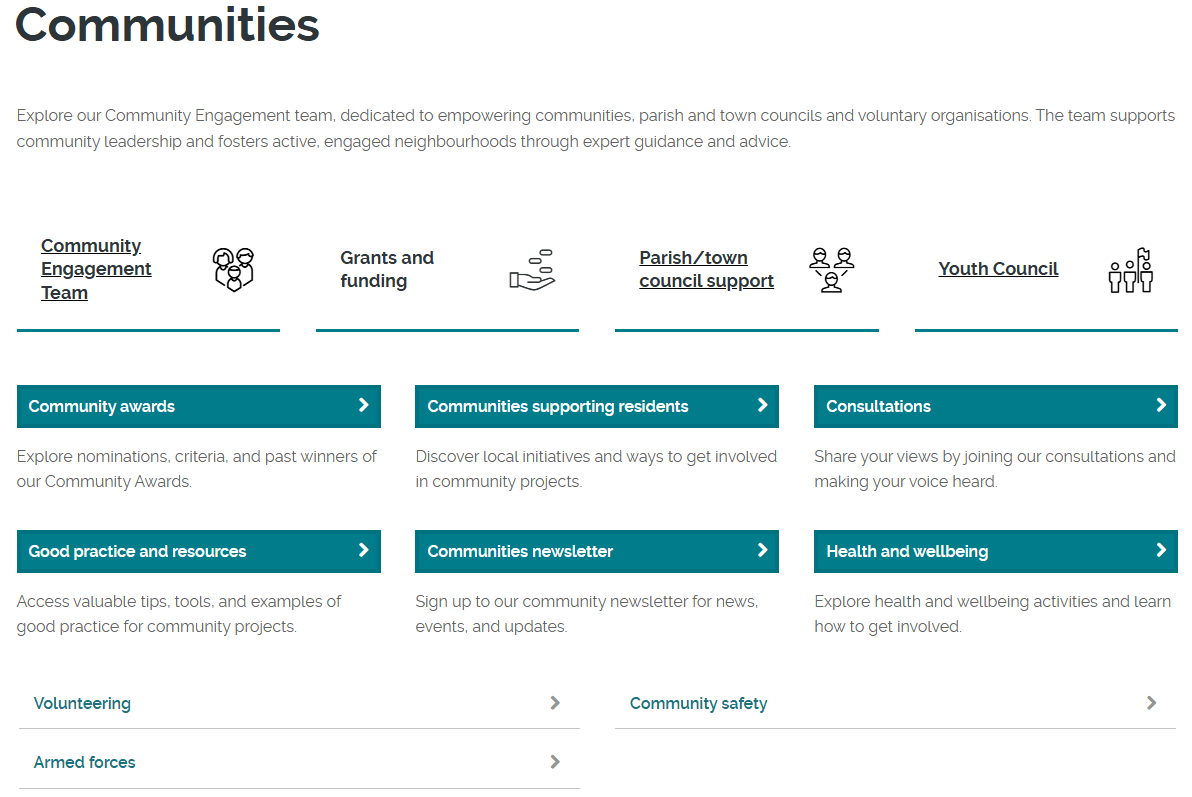
Just a reminder about our Communities webpages. These pages provide a handy, user-friendly hub where you can find information on a wide range of topics, not just related to the work of our team, but also to wider HDC community initiatives.
Have a look around and tell us what you think and let us know if there are other resources that you'd like to see from the team. |
|
|
Volunteers' Week 1-7 June
Volunteers’ Week is a nationwide annual campaign that takes place from the first Monday in June, dedicated to recognising and celebrating the impact of volunteers. Many organisations use the week to promote volunteering and recognise their existing volunteers. |
|
|
First introduced in 1984, the campaign has been marking over four decades of appreciation, giving organisations and communities an opportunity to acknowledge the dedication and achievements of both past and present volunteers.
|
|
|
It showcases the wide range of volunteering taking place across the UK, bringing together people and groups through a shared commitment to supporting others.
Volunteers’ Week takes place from Monday 1 to Sunday 7 June. |
|
|
How can we get more volunteers? A longer read for groups who are thinking about volunteer recruitmentFinding volunteers is one of the biggest issues that voluntary and community groups face (along with finding funding). When there's a volunteering role to fill, it's tempting to dive straight in, write a role description and publicise it through social media and other routes.
If responses are thin on the ground, the problem often isn't the opportunity itself; it's that the message hasn't been shaped around what actually motivates people, or conversely what puts them off. Taking a step back before you start recruiting and asking why someone would want to do this, and what might make them hesitate can make all the difference in whether or not it's successful.
Over the past couple of years, the national Community Life Surveys found that volunteering has been at its lowest rates since the survey began.
In 2024/25 17% of adults volunteered formally (e.g. for an organisation or group) annually, down from 27% in 2014, and 24% volunteered informally (e.g. helping out in their community but not as part of a group) compared to 45% in 2014.
Groups often tell us that they are struggling for volunteers. The 2023 Voluntary Action LeicesterShire State of the Sector survey found that 43% of respondents had problems finding and keeping volunteers. Yet some organisations do buck the trend and have to turn volunteers away.
Why are some organisations more successful in recruiting and retaining volunteers than others?Certain factors can make some organisations and groups and some volunteering opportunities more attractive. For example:
Volunteering that is meaningful – people can see they are making a difference. Volunteering where people feel valued - "We’re part of the team, not just a volunteer”. Volunteering where people feel competent and a sense of autonomy – some people want to learn new skills, but for others using existing skills and sharing their knowledge with others is more important. Volunteering where people feel a sense of connection to others and that they were part of something bigger - “We’re a family here, everyone looks out for each other”. Linked to this, evidence suggests that peer support from other volunteers is more highly correlated with volunteer performance, satisfaction and retention than support from paid staff - so ensuring that your volunteers can connect with other volunteers if they want to is important.
What stops people from volunteering?The Community Life Survey tells us why people don't volunteer (see box below). Looking at these, we can break the population down into different categories to help us to think about different remedies for different situations:
People who already volunteer (who may or may not want to take on further opportunities - be careful of volunteer burnout!). |
|
|
People who might volunteer if only they knew about it - for example the 17% who have never thought about it, the 10% who don't know groups that need help, the 9% who don't know of any opportunities, and even the 7% who think they're not the right age (they'll be the right age for something!) or the 6% who say they are new to the area - volunteering is a great opportunity for them to get involved in their local community and meet their neighbours, see Wendy's story below!
People who might volunteer if something was changed about the opportunity - for example people who work or have caring responsibilities may need to volunteer at different times in the day, or may need something that they can do with family, or tasks they can do from home, or a buddy who they can swap with if they are unable to do certain things. |
|
Why people don't volunteer
51% - I have work commitments 32% - I do other things with my spare time 22% - I have to look after children 17% - I have never thought about it 11% - I have an illness or disability that I feel prevents me from getting involved 10% - I have to study 10% - I don't know any groups that need help 9% - I haven't heard about opportunities to give help/I couldn’t find opportunities 8% - I have to look after someone who is elderly or ill 7% - I’m not the right age 6% - I'm new to the area 5% - It is not my responsibility |
|
|
People who are very unlikely to volunteer at this particular time - the barriers may be too great - they may volunteer in the future but at the moment these are not your target for volunteering. According to the Time Well Spent research (see below) this is 28% of the population - so that leaves a massive 72% of the adult population who do or potentially would volunteer.
|
|
|
Other concerns about volunteering identified in NCVO's Time Well Spent research in 2023 included:
33% - I don't want to make an ongoing commitment 14% - I'd be worried I haven't got the right skills or experience to help 14% - I'd be worried I might end up out of pocket (e.g. transport costs to go volunteer) 14% - I would be put off by all the associated bureaucracy/administrative processes 12% - I would be worried that I wouldn't fit in with the other people who were involved 10% - I don't think my existing skills/ experience could be used 6% - I would be worried about the risks 4% - My family/ partner wouldn't want me to get involved 3% - I have been put off by negative experiences giving unpaid help in the past 2% - I have an illness or disability related to covid-19 that I feel prevents me from getting involved |
|
|
These are all genuine concerns and something for volunteer-involving organisations to think about when structuring and communicating opportunities.
Why people do volunteer and how can their motivations fit with your volunteer opportunities?
People volunteer for different reasons - for some it's a particular cause or organisation perhaps that they or their family or friends have connected with, others want social contact - new friends or a way to structure their time, some want to "give back", others to learn new skills or use the skills that they have. If organisations are able to connect with these motivations to structure and advertise opportunities, there is more chance of recruiting and keeping volunteers. |
|
|
These are the reasons given in the Community Life Survey as to why people volunteer:
46% - I wanted to improve things/help people 31% - I had spare time to do it 29% - The cause was really important to me 26% - I wanted to meet people/make friends 23% - I felt there was a need in my community 23% - I thought it would give me a chance to use my existing skills 20% - Its part of my philosophy of life to help people 16% - It was connected to the needs of my family/friends 14% - I thought it would give me a chance to learn new skills 13% - Its part of my religious belief to help people 11% - My friends did it 10% - My family did it 9% - I felt there was no one else to do it 5% - It helps me get on in my career 2% - It gave me a chance to get a recognised qualification |
|
|
What factors should you consider to encourage more people to get involved?
There's a mix of different concerns that people have related to volunteering. Some of these are practical about the time commitment, flexibility, getting expenses paid, the process to get involved, transport. Others are more relational - will they meet new people, will it help them in other aspirations, can family and friends be involved. See the final statistic relating to how many people wouldn't get involved, which indicates, as mentioned above, that 72% of people potentially would. |
|
|
From Time Well Spent 2023 - what would encouage people to be involved:
30% - If I could be flexible with the time committed 26% - If I could be flexible about the way I gave my unpaid time (e.g. do it from home etc.) 15% - If someone asked me to get involved 12% - If I knew about what opportunities to give unpaid help were available 12% - If my family/ friends got involved with me 11% - If I could meet new people 10% - If I knew I could get any expenses paid 9% - If someone could provide transport when I needed 8% - If the process for getting involved was easier and quicker 8% - If I knew it would benefit me in my career/ job prospects 8% - If my employer supported/encouraged it 5% - If I knew it would help me improve my skills 8% - Don't know 28% - Not applicable - nothing in particular would encourage me to get involved |
|
|
What are the benefits of volunteering?
For people who do get involved in volunteering, there are a huge range of benefits that you can promote to potential volunteers. |
|
|
Time Well Spent - what people get from volunteering:
89% - I enjoy it 89% - It makes me feel I'm making a difference 88% - It gives me a sense of personal achievement 87% - I meet new people 81% - It broadens my experience of life 75% - It improves my mental health and wellbeing 74% - It brings me into contact with people from different backgrounds or cultures 73% - It gives me more confidence 72% - It gives me new skills and experience 68% - It helps me feel less isolated 48% - It improves my physical health 39% - It improves my employment prospects |
|
|
How can your group use this information?
So what does all this mean in practice? The statistics in this article are useful, but only if they prompt some reflection on how your group presents itself. Here are some straightforward things you can do:
Read through and think about how you can use the information. There are some pointers below, but reading the statistics may enable you to reflect on factors specific to you. Lead with what volunteers gain, not just what you need. People are drawn to volunteering for all sorts of reasons — connection, purpose, new skills, getting out of the house, structuring their time. Make sure your promotional material speaks to those motivations, not just the task that needs doing. And the research tells us that the benefits are real: the vast majority of volunteers say they enjoy it, feel they're making a difference, and that it improves their mental health and wellbeing. Let your existing volunteers do the talking. A short quote, a brief case study, or a friendly photo from an existing volunteer will help people to get a feel for the organisation - particularly if you show a range of people that potential volunteers can identify with. Think about flexibility. Flexibility is one of the biggest factors in whether someone takes the plunge, whether that's choosing their own hours, doing things from home, or helping in a more ad hoc way. If your group can offer any of this, say so clearly. Many groups can but simply don't think to mention it. Address concerns head-on. Many people quietly worry they won't fit in, won't have the right skills, or that it'll cost them time and money they can't spare. Be upfront: make clear that no experience is needed (if that's true), show that your group is welcoming and mixed, and always aim to cover out-of-pocket expenses. If transport is a barrier, consider whether you can help with that too. Reduce bureaucracy. Complicated sign-up processes put people off. Keep things simple, low-commitment to begin with, and make sure people know exactly what happens next. A named contact and a warm welcome message go a long way for someone who's not sure. Ask people personally. A significant proportion of people say they'd volunteer if someone simply asked them directly. A personal ask, from a friend, a neighbour, or an existing volunteer, can be far more powerful than a general social media post. Encourage your current volunteers or others involved with your group to spread the word and, better still, to bring someone along with them. Make your group visible. A surprising number of people say they don't volunteer simply because they didn't know opportunities existed or couldn't find them. Make sure you're easy to find: online, in local spaces, and through word of mouth. Look at your organisation through fresh eyes. The research tells you what people are thinking, the task now is to make sure your promotion, recruitment processes and volunteers experience in the role reflects that. |
|
|
For more information:
NCVO's Time Well Spent suite of research has a huge amount of information and insight from over 10,000 volunteers, including a diversity report of what different groups of people think about volunteering. The Investing in Volunteers Quality Award is an evidence and experience-based guide to good practice in volunteering. You can download the standard and work through it without signing up for the award, although if you do sign up you will have access to further guidance, including some geared to particular types of volunteering, and the support of an assessor to develop it. Voluntary Action LeicesterShire provides local support around a range of subjects related to volunteering. |
|
|
|
Opportunities to get involved
|
|
|
Improving access to services and activities particularly in rural areas |
|
|
We are continuing on our mission to try to create a more joined up way of working for services across the district through a number of routes. We understand that systems of support are often complex and can be incredibly difficult to navigate, and these difficulties can be further exacerbated in more rural areas of the district. We regularly hear that services can struggle to reach those in the more rural areas, and that residents in these areas are often either unaware of support services available, or find it difficult to access them.
Shaping the Crisis and Resilience Fund Community Coordination strand
This month we have responded to the consultation about how the Community Cohesion and Coordination strand of the Crisis and Resilence Fund will operate locally. Leicestershire County Council will be procuring this service in the next few months - it focuses on strengthening local coordination of support services; improving partnership working across statutory services VCSE organisations, and community groups; addressing service gaps, duplication, and fragmentation; and improving residents’ ability to access appropriate support through clear pathways and trusted local connections. It will work alongside the direct support to individuals provided by the fund. Since the HDC Community Engagement Team has already worked on a model for delivery in the Harborough district, we have contributed learning and resources from the development and consultation we've already done to ensure that the needs of a predominantly rural district are taken into account.
Mapping and supporting local activities so HDC can better support residents in need
We are also continuing to build up a map of the services and activities within Harborough so that HDC fronline departments, starting with customer services, will have clearer routes to refer residents with support needs. Some of this is ensuring that staff know of the existing services, but our mapping shows that while there is service provision in towns and larger villages, there are rural parts of the district that are massively under-served. Last year's HDC councillor Ward Improvement Grants have helped to fill some of those gaps, for example a walking group for people with Parkinson's, a village lunch club, developing youth clubs, all initiatives where local people have spotted a gap and are working, mainly as volunteers, to fill, and we will be reporting on projects in future editions of this newsletter.
|
|
|
Community based support hubs
One model we are developing to tackle these issues is the development of support hubs within communities that can offer differing levels of support. Our initial focus has been around financial and digital support as we understand there is a district-wide need for this, though other support services could be involved as well so that residents are able to get truly holistic and comprehensive support. |
|
|
We know that access to services particularly in our more rural areas can often be limited and restricted, with transport being an additional barrier. One option we are keen to explore for these areas is the idea of mobile or satellite hubs (also mentioned in the VASL article below).
|
|
|
What is a mobile or satellite hub?
|
|
|
A mobile or satellite hub would be a collection of services and activities that visits different areas at different times. While this happens at static venues such as The Well Kibworth, the Churchgate Centre in Lutterworth, and Cafe Fifty Five, it is more difficult to coordinate in smaller villages. This could allow the opportunity for local services to "pop up" in the area on a given day and time, giving local residents the chance to access support directly from a service without the need to travel, and services the opportunity to engage with local residents in areas that are usually quite hard to reach. This could be as part of an established community group, such as a coffee morning or community cafe, or as an additional event on it's own. Local volunteers could be involved to help provide ongoing support and signposting to residents.
| Next steps - bringing parishes, charities and community groups together
Would this be something that would be beneficial to the residents in your parish? Do you have an ideal location that this could be held? Would your service welcome the opportunity to be a part of a network of outreach support? Would you benefit from learning from what has and hasn't worked in other areas?
We are looking at coordinating a webinar or event where district charities and parish councils, meetings and other community groups come together to look at how this might work so let us know if this is something you'd be interested in. Whatever your thoughts or views, we want to hear from you! |
|
|
| | |
Community Grant updatesUnderspend round - opens 26 June 2026
The final round of year two of the Community Grant will be an underspend round and the provisional dates for this are 18 June to 3 August 2026 to be confirmed. Full details about how to apply and supporting examples and templates are online.
Please note the dates have changed slightly from those originally suggested due to change in committee dates. The underspend round will not necessarily protect any unused town or parish allocation. If there are more applications than funding available, assessment criteria will be considered to prioritise applications. In this round, groups will be able to apply for any remaining underspend pot where any one of the following applies:
- They are groups that deliver services across the district who have not been able to apply previously. Evidence will be required of existing services or activities delivered in the district.
- They are in parishes who have not received any Community Grant funding in the second year or who have not used their full allocation. No funding will be given to a group that takes a parish above their individual allocation (in the case of small parishes, this is maximum £5k).
If you know you are definitely going to apply for the grant in round four, it would be helpful to let the grants officers know about your intentions in advance.
As before, Grants Officers are available to support you with applications and answer any questions you may have. Please continue to share your project ideas with us - we may be able to advise on eligibility and how to apply for the new Community Grant, or suggest alternative sources of funding.
Download the guidance for full information about how to apply and contact Claire and Serretta at communitygrants@harborough.gov.uk to talk through your project.
|
|
| |
Grants Webinar - 6 July at 2.30pm Grants Webinar – Booking form
Follow the above link to book onto onto our live Teams webinar with the Community Engagement Team. This will be informal with lots of chance to ask questions.
This webinar will focus on a step-by-step walk through the Community Grant application portal/form on Grantapproval, including the information required under each question, what makes a good application and how to demonstrate community need and benefit. Attendees are also welcome to ask any questions related to the application process or projects they are considering. |
Encouragement to contact us! |
|
|
We've recently carried out a survey with year one grant recipients, and these were some of the comments that people made about the support they received, so please get in touch:
“Support from the Grants Officer was invaluable in getting the application correct.” “Telephone support by the grant officers was very helpful, and we felt that they took time to fully understand our project.”
|
|
|
“The enthusiasm and friendliness of the grants team [was particularly helpful].”
|
|
| | |
It’s great to see eligible groups utilising the grants available with HDC and applying for both S106, Community Grant and Environmental Grants. To see if there is S106 funds for your community, please see the available funds here.
Katie Fox is always keen to discuss any possible projects, contact her at grants@harborough.gov.uk |
|
|
|
Youth Council activitiesWhat the Youth Council has been working on |
|
|
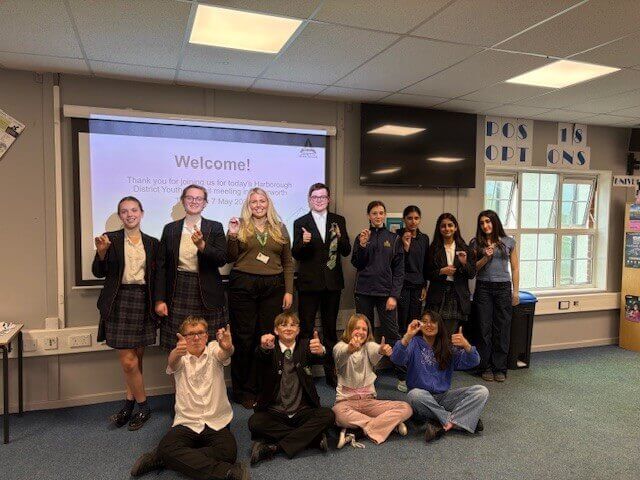
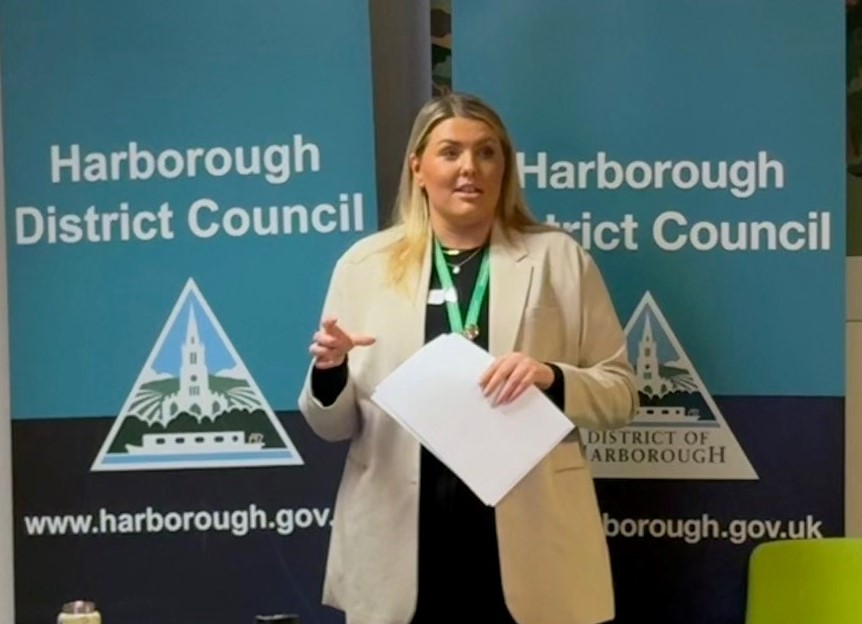
At the last meeting on Thursday 7 May, held in Lutterworth, we welcomed Alison Jolley from Young Leicestershire (pictured below) to speak to the young people about consultation for youth groups and to gather their views and ideas of how to find out what young people really want and the best way to reach them.
|
|
|
We then looked at creating an end of year review document and thinking about what we’d like to share with people about what the Youth Council has achieved this year. The young people placed sticky notes on a timeline of this academic year of their different experiences and achievements. It was great for them to reflect on everything that's happened and the end of year review document will be an opportunity to share this with stakeholders.
|
|
|
Earlier in the year, after the collaboration with Speak Out magazine, our Youth Council logo was created. We have been thinking about ways to launch the logo and share it with the public to raise awareness; one of the first steps has been to have badges created and at the last meeting each Youth Council member was presented with their own badge, pictured to the right. We are also giving badges to staff that have attended the Youth Council to inform or consult them.
|
|
|
As the Youth Council 2026 elections are coming up to appoint the new Leadership Team for the 2026/2027 academic year, we then looked at the person specifications for the roles. The young people thought about what questions they might ask the candidates standing for roles which they can ask them at hustings, which we are doing at the next Youth Council meeting on Thursday 4 June in Market Harborough. Some questions they came up with for the different roles were:
What leadership experience do you have? For example a sports club or at school. How confident are you in talking to new people? How would you influence people to join? How would you plan a Youth Council meeting? Can you share an example of your experience with money and budgets? What experience do you have in writing, photography, design or social media? |
|
|
|
Youth Council members have been invited to stand for roles and are currently spending time writing their manifestos, ready to share at the next meeting. Online voting for Youth Council members will open and the roles will be announced in the last meeting of the academic year in July. Over the summer, the new Leadership Team will spend time transitioning into their roles ready for the new academic year. Kibworth Mead Work Experience Students at MHBS |
|
|
Becca recently attended a work experience session at Market Harborough Building Society, (pictured left) invited by Nicola Moss from The Business Hub Work Experience CIC. This programme provides young people with a week of work experience consisting of different workshops and guest speakers. Becca was invited to talk to Kibworth Mead students about the Youth Council and the Young People's Strategy that is currently being revised.
|
|
|
This was a great opportunity for the young people to share their thoughts and ideas about the priorities the Youth Council have identified:
Skills, careers and employment Environment and climate action Affordable housing and independent living Youth engagement and voice Activities, youth groups and 'places to go'.
We want to capture the views of young people across the district when revising HDC's Young People's Strategy to ensure we are hearing a wide, diverse and inclusive range of voices. The young people engaged well with thinking about the five priorities and shared their ideas back to the group. They identified things like social anxiety and lack of confidence prevents young people from seeking opportunities or attending youth groups, a lot of activities are sports based and they would like more places to just 'hang out' or play games and enjoy shared hobbies. They would like early support with careers and employment so they feel prepared when the time comes, as well as communication skills support. Their comments will feed directly into the Young People's Strategy and help to shape it so it works for young people.
If you are involved in a young people's group that would be interested in inputting to the Young People's Strategy, please contact Becca at youthvoice@harborough.gov.uk to find out more. Next meeting
This will be on Thursday 4 June 5:30pm-7:30pm in Market Harborough. This meeting will focus on hustings for our Youth Council elections. |
|
|
|
Join the Youth Council! We are always keen to welcome new members. We have monthly meetings on a Thursday 5.30pm-7.30pm. The meetings alternate between Lutterworth and Market Harborough each month. We provide transport through Lutterworth Community Transport and Market Harborough Community Transport to make the meetings as accessible as possible. |
|
|
If you are a young person aged 11-18 interested in the Youth Council, or know of any young people you think might be interested in attending future meetings or if you have any questions or queries for Youth Engagement Officer, Becca Powell (pictured left at a Youth Council meeting) please contact her at youthvoice@harborough.gov.uk.
|
|
|
Although we have participants from across the district, we would also like to make sure young people from all secondary schools and colleges in the area are equitably represented, particularly in areas around Kibworth Mead Academy and Thomas Estley Community College. So get in touch with Becca if you can help with this or know young people in those areas who would like to get involved.
|
|
|
|
Spotlight on volunteering projects from HDC grants
This section demonstrates some of the projects that have been funded from either Community Grants or Ward Improvement Grants over the previous couple of years. If it gives your group some ideas and you would like to talk through projects, please contact Grants Officers Claire and Serretta at communitygrants@harborough.gov.uk or see our website.
Voluntary Action South Leicestershire (VASL) |
|
|
We met with Julia Synnott, Charity Manager, in VASL's new premises to hear more about her role, the work of VASL and their recent Community Grant project, which provided funding for them to make the office friendly and welcoming and a functional space to work and welcome guests.
|
|
|
This is what Julia (pictured below) told us about the organisation, the people who use its services and the many volunteers that support projects:
VASL is a local charity that has been supporting people across Harborough District and Leicestershire since 1987. We support carers, older people, isolated individuals and those experiencing mental health or wellbeing challenges through services including community transport, befriending, wellbeing support and dementia support. A huge part of our work is helping people feel connected, supported and able to remain independent within their community. We work closely with volunteers, local partners and other organisations to respond to the changing needs of local people. Thousands of people every year are supported by a mixture of 16 paid professional staff and a fantastic team of 150 volunteers. We currently run a range of services including:-
- Support for Carers Leicestershire - support for unpaid carers (currently over 8,500).
- Community transport scheme - 48 volunteer drivers (70,000 miles per year).
- Community Champions - befriending/running community activities for older people (63 volunteers, 70 clients and 60 digital clients).
- Mental wellbeing support - (24 volunteers and 70 clients)
- Dementia support for carers and families - supporting over 50 families (6 trained volunteers)
Mainly focused on the operational side of running the charity, a large part of my role involves making sure the organisation remains sustainable, responsive and able to continue delivering high quality support to local people. While much of this work happens behind the scenes, it is essential in allowing our frontline services and volunteers to make a real difference in the community. |
|
|
How do you feel the community benefits from all the services which VASL offers?
I think the biggest benefit is that people feel less alone and more connected. Many of the people we support are isolated due to age, caring responsibilities, poor mental health, disability, dementia or lack of transport. Our services help people maintain independence, confidence and wellbeing. For example, our transport service helps people attend medical appointments and social activities and our befriending and wellbeing projects help reduce loneliness. |
|
|
In addition, our carers support helps unpaid carers feel recognised and supported and our volunteers provide companionship and reassurance, often becoming a lifeline for individuals. We also create opportunities for people to reconnect with their community, which has a huge positive impact on confidence and mental wellbeing.
In terms of your recent Community Grant for partitions and furniture in your new premises, in what way do you feel these will help VASL to provide its services?
The funding has made a huge difference to our new office space. Previously, we were based out of town, which made us less visible and harder for people to access. Moving into a high street location has already helped improve awareness of VASL and made us much more approachable for local residents and volunteers. The funding for the partitions and furniture has allowed us to create a welcoming, professional and flexible environment that genuinely works for the community.
We are now able to hold confidential one-to-one meetings in a private space; run small groups, drop-ins and wellbeing activities; offer a comfortable soft seating area where people can drop in and feel relaxed and welcome; create a more accessible and community-focused environment for visitors, volunteers and staff. We have already used the space for gatherings, training volunteers and meeting clients. The space would not have worked or been possible with out the support of HDC. It now reflects the quality and professionalism of the services we provide, while also feeling warm and inclusive. It has really helped us create a community hub rather than simply an office.
What do you all find the most rewarding part of the work which VASL does?
|
|
|
One of the most rewarding things is hearing from people who tell us that VASL has given them confidence to leave the house again, helped them cope with caring responsibilities or simply made them feel that someone cares.
In addition, it is rewarding to see the relationships that develop between volunteers and the people they support. Often what starts as practical help becomes a trusted friendship that makes a huge difference to someone’s wellbeing |
|
| |
What challenges do you have reaching out into villages in some of the more rural areas of the district?
Many people living in rural villages have limited public transport, especially older people or those who do not drive. This can leave people feeling isolated and unable to access services, groups or appointments. We also find that some rural residents can feel overlooked or disconnected from what is happening in the wider district. Information does not always reach people easily, and some individuals may be reluctant or unable to travel into town. Recruiting volunteers in rural areas can also be challenging because travel and time commitments can be more difficult.
Is there anything that you've done that has been successful in any of the smaller villages? Yes - taking services directly into communities has worked very well. For example, outreach roadshows and community sessions in villages helped people feel heard and included rather than forgotten. When services are brought closer to people, engagement is often much stronger.
We have also seen success through partnership working and using local community spaces to hold activities or drop-ins. One idea we think has real potential is developing more “satellite hubs” in rural areas - similar to banking hubs - where different charities and services regularly attend a local venue on set days. This could make support far more accessible for rural residents. |
|
|
What would you like to do, what challenges do you have and how could we help you?
We would like to continue expanding outreach into rural communities so that support is not dependent on someone being able to travel into Market Harborough. The main challenges are funding and resources; volunteer recruitment in rural areas; transport limitations and finding suitable local venues and sustainable ways to deliver services.
Support from the council in areas such as community transport, promotion of local volunteering, partnership opportunities, and access to community spaces would make a significant difference. There is also huge value in organisations working together to create more localised support hubs within villages and smaller communities. |
|
|
What do you think has made VASL so successful at involving volunteers?
We invest heavily in supporting our volunteers through training and ongoing support; regular communication; flexible opportunities; recognition and appreciation events and creating a welcoming and supportive culture. Volunteers are at the heart of VASL, and I think people volunteer with us because they feel valued and can see the difference they make. |
|
|
Many volunteers stay with us for years because they enjoy the sense of purpose, community and connection. We also try to match volunteers with roles that genuinely suit their interests and strengths, which helps create meaningful experiences for everyone involved.
What are the challenges voluntary-run organisations face?
The biggest challenges are usually funding, increasing demand for services and volunteer recruitment and retention. Many charities are supporting people with increasingly complex needs while also facing financial pressures themselves. There can also be challenges around capacity and staff burnout; rising operational costs; accessing long-term sustainable funding ; reaching isolated communities and encouraging younger people or working-age adults to volunteer when people are already stretched for time.
Despite these challenges, voluntary organisations play a hugely important role in supporting communities and often provide early intervention that prevents bigger problems later. |
|
|
What advice would you give to someone who is thinking about doing voluntary work or setting up a group, but perhaps worried about the commitment or lack of knowledge?
I would say start small and don’t underestimate the value of what you can offer. People often think they need specialist skills or lots of spare time, but even a small amount of time can make a real difference to someone else. Volunteering can also be incredibly rewarding personally, It helps people build confidence, meet others, learn new skills and feel part of their community. For anyone setting up a group, I would say don’t be afraid to ask for help and build partnerships.
Most organisations and communities are very supportive, and there are lots of people willing to share advice and experience. You do not have to do everything perfectly from the start - the important thing is responding to a genuine community need and being willing to listen and adapt. If you are interested in volunteering or would like to contact VASL for their support, Julia would love to hear from you:
Telephone : 01858 433232
Email : admin@vasl.org.uk
Address: VASL, First Floor, The Old Bank, 40 The Square, Market Harborough, LE16 7PA |
|
|
Celebrating Volunteering at the Houghton Pavilion
Formerly known as Houghton Hub Foodbank, The Pavilion Pantry opened in March 2026 at the newly developed Pavilion on Weir Lane in Houghton on the Hill. Alongside foodbank support delivered in partnership with Leicester South Foodbank and Trussell, the Pantry now also offers a welcoming community café and pantry facilities helping to reduce food waste. |
|
|
The opening of the Pavilion has created an new community space for local residents and represents the result of more than six years of work by volunteers and supporters from Houghton Field Association and the wider community. Almost £900,000 was secured through extensive fundraising, grants and community support to replace the former 1970s pavilion building.
|
|
|
Funding for the project included community donations, support from external funders, Section 106 funding towards the build, a Community Grant for furniture and an Environmental Grant supporting the installation of solar panels.
The new facility has opened up opportunities for the development of the Pavilion Pantry and Community Café, creating a safe, welcoming and inclusive place where people can come together each week for conversation, support and community connection.
Every Wednesday morning, volunteers help bring the space to life. From preparing refreshments and welcoming visitors, to sorting donations and supporting food parcel collections, volunteers are at the heart of everything the Pantry does. |
|
|
Their contribution goes far beyond practical support. They help create a warm, friendly and inclusive environment where people can come together and feel valued and supported.
There is no single reason why people choose to volunteer. Some want to give back to the community, meet new people, share skills or support a cause close to their heart. Whatever their reason, every volunteer at The Pavilion Pantry plays an important role in helping local people and strengthening community connections. Everyone is welcome. |
|
|
|
Lead volunteer Wendy Tyler shares her own volunteering experience:
“When moving to Houghton on the Hill just over four years ago I knew I wanted to be involved in something in the village but was not sure what. Shortly after I heard about the proposed food bank being set up here and decided to become involved. The opening of the food bank in May 2023 tied in with me taking early retirement so everything fell in to place nicely. As I was not working I volunteered at several of the sessions and soon became one of the regular volunteers. About a year later I was asked if I would consider becoming a team lead which I did and was trained up for this position over the coming weeks.
"As I was new to the village and although I knew a few people who lived here already being part of the food bank has introduced me to many more friends in the village and the wider area. It is a very welcoming group of people who are happy to help you until you are fully trained and confident with what needs to be done.
|
|
|
"Over the last three months the food bank has evolved into the community cafe and pantry (pictured here in action) as well as the food bank which has always the long term plan. With the opportunity to move to the pavilion in the village we are now able to offer a safe and friendly place everyone from the local area to come together once a week and have a chat and a bit of cake. There is also a community pantry which is available to everyone where people can take, swap or donate any of the items available if they want to.
|
|
|
"Being part of the Foodbank and Pavilion Pantry has given me the opportunity to meet new people and make new friends as well as helping vulnerable people in need. I would definitely recommend anyone to get involved as helping to make someone’s life a little easier is one of the best feelings in the world."
For more information and contact details see the Pavillion Pantry's Facebook page. |
|
|
Volunteer's Week - volunteering in Lutterworth |
|
|
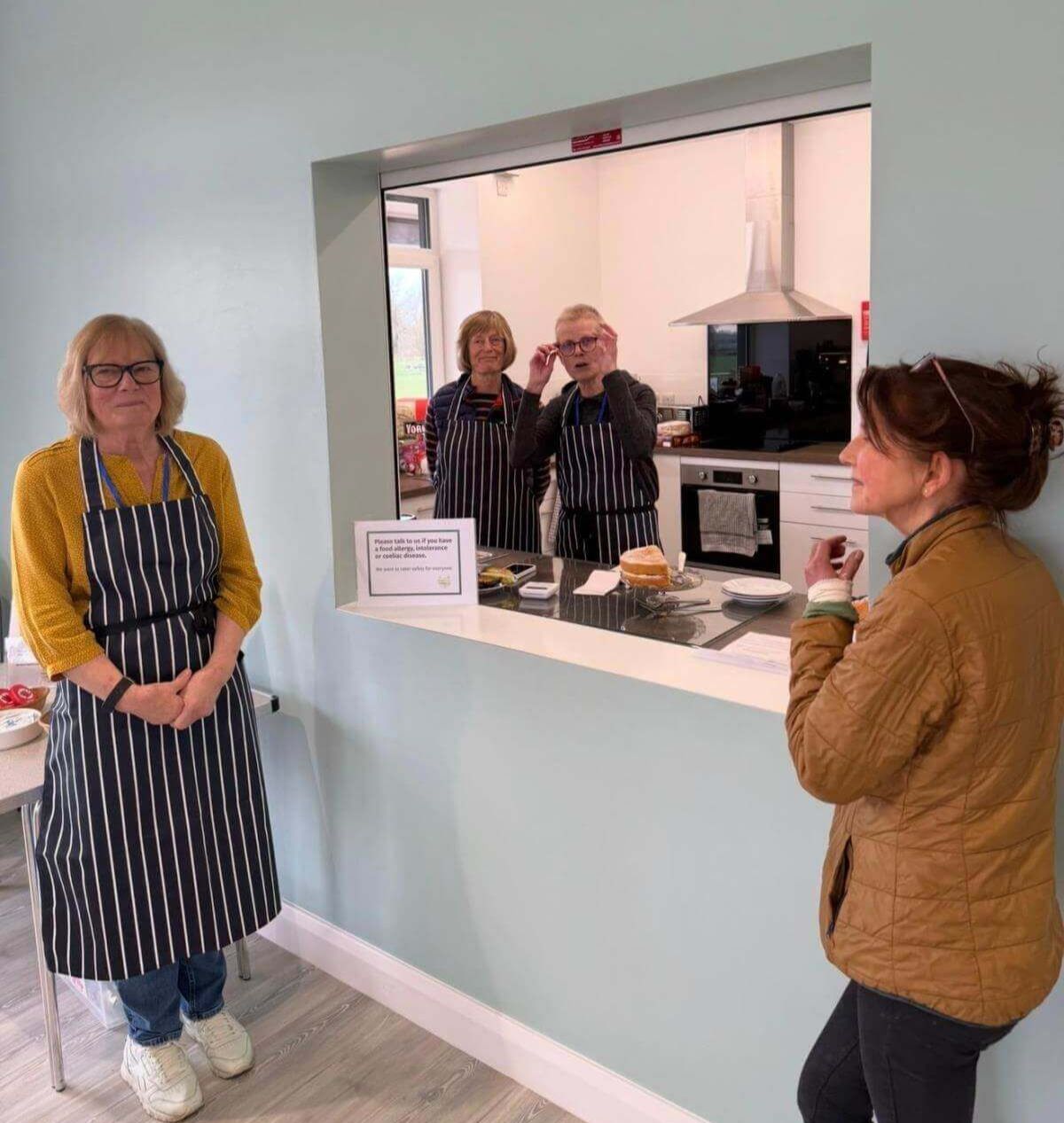
In celebration of Volunteers’ Week, our Community Development Officer, Gemma, visited the Churchgate Centre in Lutterworth to speak with Tor Berry, Community Development Lead, and other volunteers about the impact of volunteering for their organisation.
St Mary’s Church and the Churchgate Community Centre work with around 40 regular volunteers who faithfully support a wide range of projects throughout the year, including the Open Kitchen, Help Hub, Veterans’ Breakfast, Little Acorns Toddler Group, Summer Club, Church Café, Foodbank, and more. Every one of these services depends on their commitment, reliability, and generosity. None of it would be possible without the strength of the teams of volunteers. |
|
|
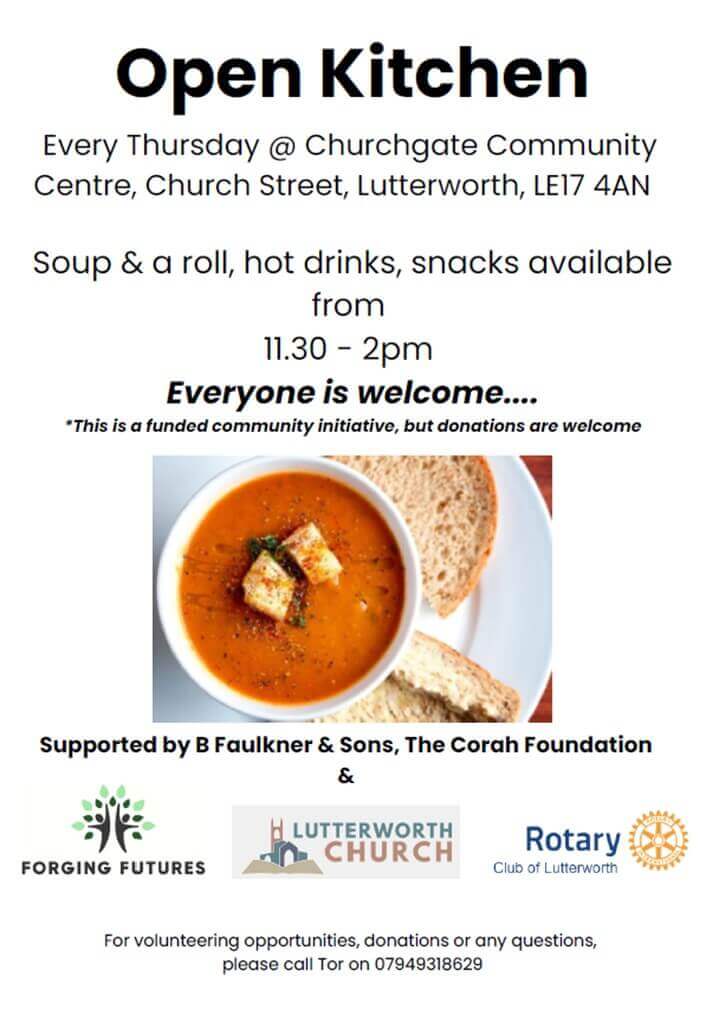
A real success story for the Churchgate Community Centre is the weekly Open Kitchen, when a team of volunteers provide soup, a roll, hot drinks and sometimes even cakes to guests who visit. The team create, not just meals, but a genuine sense of welcome and belonging to anyone who comes through the doors. There is a real buzz in the building as volunteers and guests come together, sharing food, conversation and community.
"At St Mary’s Church and Churchgate Community Centre, volunteers are the lifeblood of everything we do. As a busy community church, we rely entirely on volunteer teams to run a wide range of projects that serve people across Lutterworth, and surrounding villages." Tor Berry, Community Development Lead. |
|
|
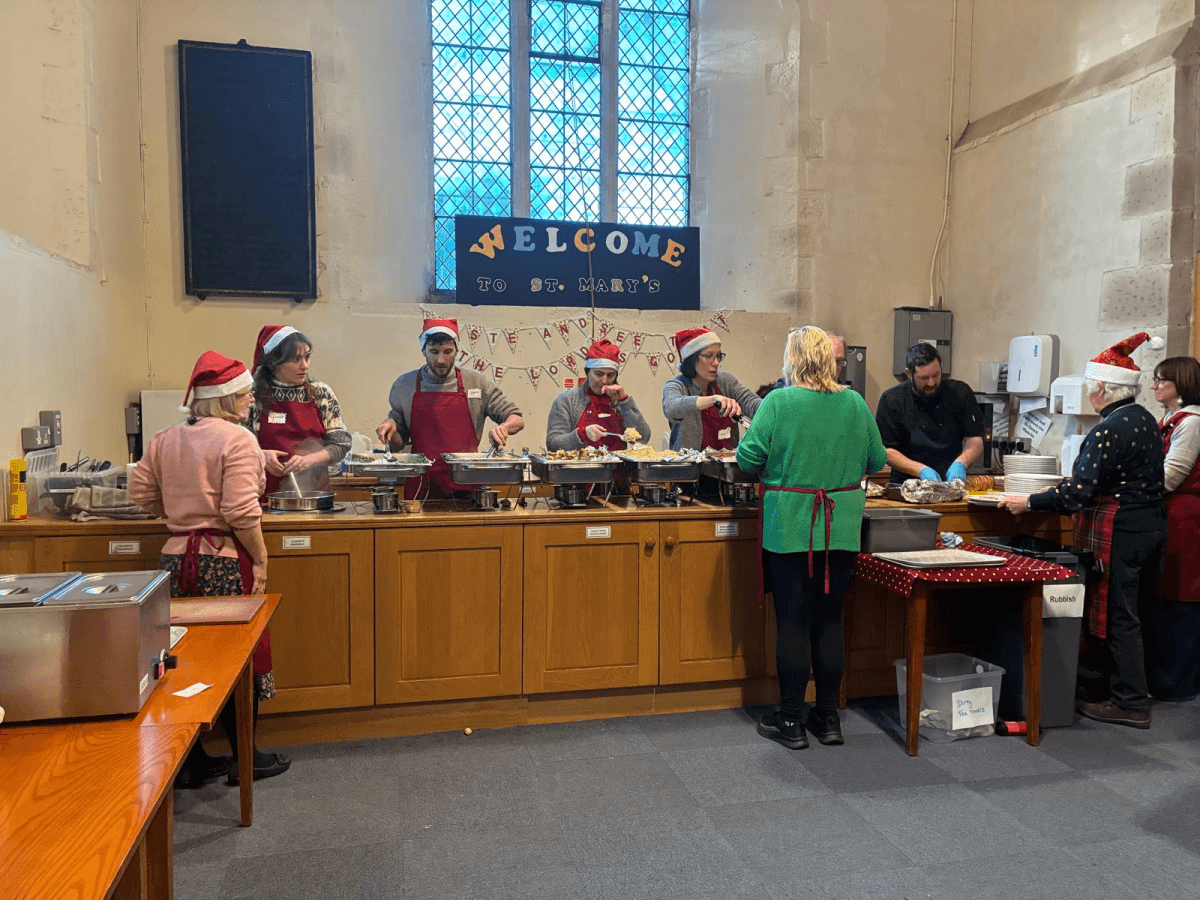
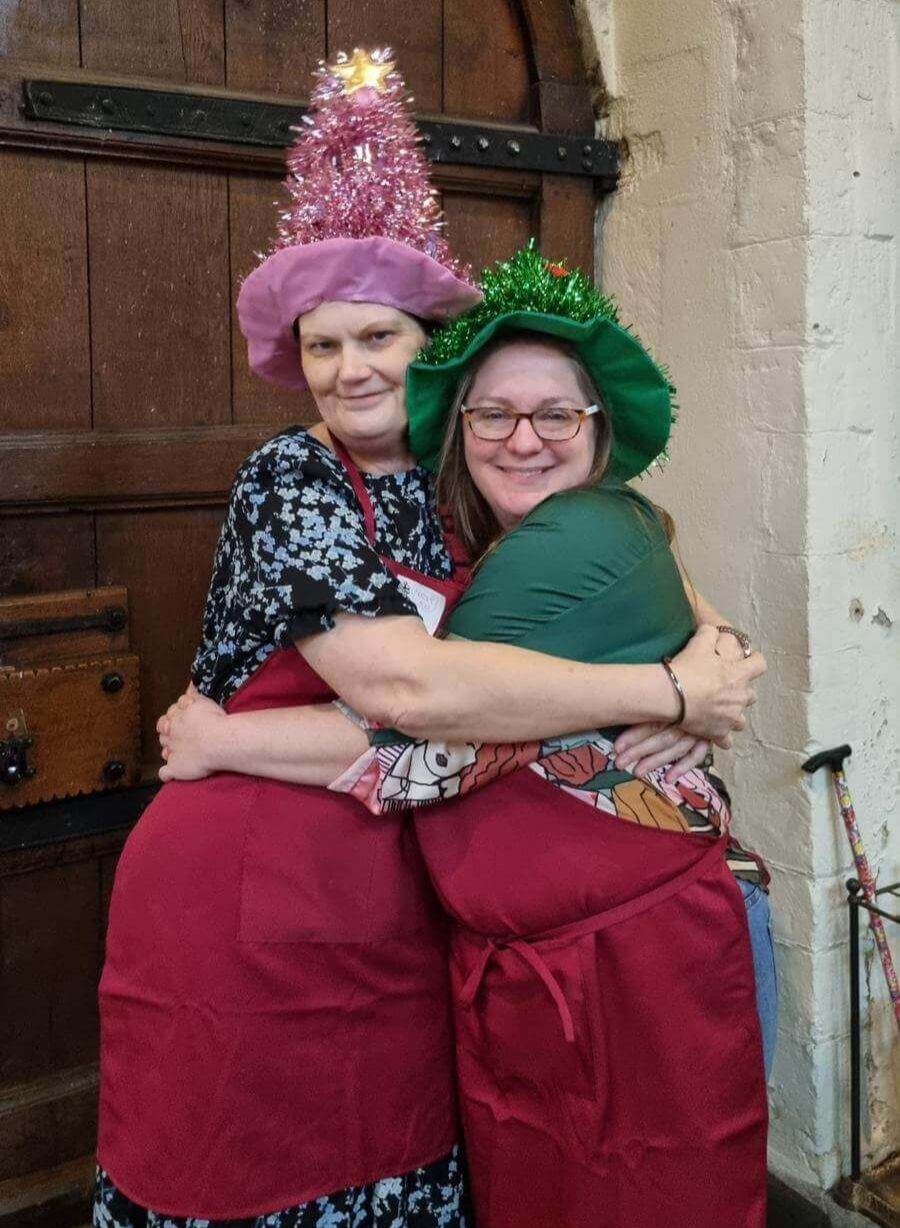
One project they are extremely proud of is their Open Christmas, pictured below left. This happens on Christmas Day itself, when around 60 people gather for a shared lunch—many of whom would otherwise spend the day alone or without company.
|
|
|
From the planning, organising, and preparation, to transport, cooking, and delivering such a wonderful event on the day, it is an entirely volunteer-led operation, that is deeply valued by all involved. It is such a great example of people coming together offering warmth and companionship to support their community at a time of year when it is most needed, with many volunteers agreeing, “It’s the best way to spend Christmas and what Christmas is actually about”.
|
|
|
Blooming Lutterworth is another volunteer-led initiative in which a group of inspiring volunteers give their time throughout the year to maintain and care for planted areas across Lutterworth. They quietly give their time to transform public spaces, helping to make Lutterworth a more welcoming and attractive place for everyone.
The Summer Club at St Mary’s Church provides an opportunity for young volunteers in the area. Engaging in a Junior Leadership programme, teenagers take part in a leadership course and safeguarding training, providing them with the opportunity to develop their confidence, responsibility, understanding and practical skills to support working with children in the summer club safely and effectively.
Trustees are also an important part of the volunteer sector, serving across a wide range of charities and community groups, quietly giving their time, skills and leadership to keep services running and communities supported. What draws people to volunteer?
One volunteer, Martin Iliffe, describes his experience of volunteering as something that shapes how he sees people and community: “It really helps me stay grounded. You meet people from all walks of life and different situations, and it broadens your understanding of what people are dealing with day to day.”
Martin volunteers across several areas, including leading digital support at the Churchgate Community Centre, where he helps people with form filling and accessing services. He is also involved with Rotary, where his highlights include the Disability Games and the Rotary Technology Tournament, which this year involved 12 school teams from Key Stage 3 to Key Stage 5. |
|
|
Town Councillor Sarah Simms also volunteers with Age Concern Lutterworth & District and Lutterworth Community Transport. Sarah is pictured on the left, alongside Tor Berry.
Sarah says: “This is my way of giving back to a town I love. I’m proud to be part of it and to support people wherever I can, even if you only help one person a day - it is significant."
Overall, it is clear that Lutterworth town and the surrounding villages have a vibrant volunteer community, who are willing to give their time, energy and care for the benefit of projects that support across the community. |
|
|
What is mentioned here is merely a snap shot, and we know that so much more goes on, both in this area, and across the district. But, without the dedicated volunteers, many projects simply would not run and the support and opportunities available to all age groups and demographics across communities, would be vastly reduced. Thank you to all of the wonderful volunteers across the Harborough District.
More information about the Churchgate Centre and their services and for contact details are on their website. |
|
|
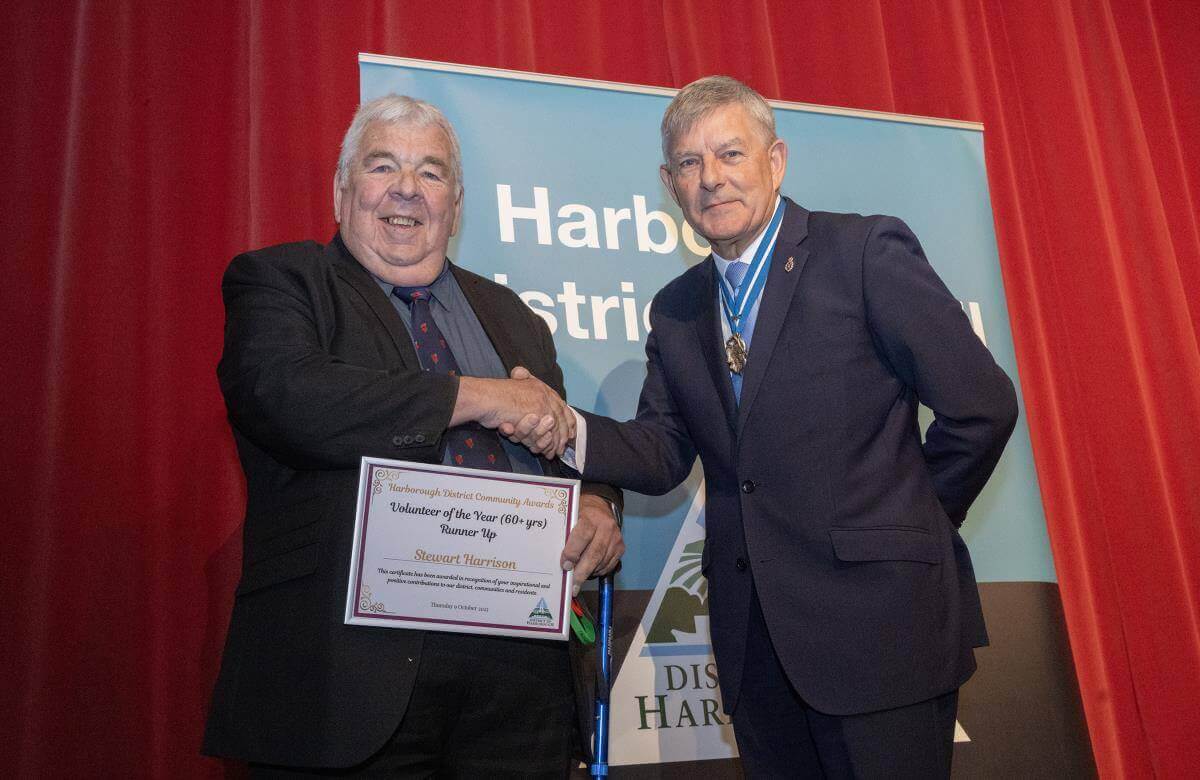
HDC Community AwardsStewart Harrison - Royal British Legion - runner up of the HDC Volunteer of the Year (60+) award |
|
|
Following a successful career in the military, Stewart Harrison has been a member of the Royal British Legion (RBL) for over 20 years, taking a more active role since joining the Market Harborough Branch. In celebration of both Volunteers' Week and Armed Forces Day in June, we thought it would be an ideal time to shine the spotlight on the brilliant work Stewart does.
|
|
|
Stewart is pictured above right getting his award from Stephen Bryant JP, High Sheriff of Leicestershire in 2025.
Can you tell me a little about your background, the work you did in the Armed Forces and your volunteering work now?
My career began in the Royal Air Force, where I joined as a Boy Entrant and rose to the rank of Corporal after six years. Following restructuring, I transferred to the Army and joined the Royal Army Ordnance Corps, again progressing quickly through the ranks. During my service, I was stationed in the UK and overseas, including Yemen, Oman, France, Holland, Belgium and Cyprus.
After leaving the Armed Forces, I joined the Prison Service in 1977 and worked there for 25 years. During that time, I completed a degree in Psychology with the Open University and later an MSc at London University. I went on to work as a Psychologist with the Prison Service and Police, and later became a Lecturer at Glasgow University, specialising in serious incidents, hostage management and offender behaviour.
Now, I volunteer with the Royal British Legion (RBL), where I help support veterans and the wider community. How long have you been volunteering with the Royal British Legion and what does your role involve?
I have been a member of the Royal British Legion for around 20 years, although I became more actively involved when I joined the local branch.
I currently serve as Branch Chairman and lead the Poppy Appeal. My role involves working with various organisations to support veterans and their families. I have worked with Regimental Welfare personnel if soldiers are in need, and with SSAFA if we know someone needs help. The RBL work with a DWP advisers to help veterans with their benefits, and can support people with debt and work advice. We also support in organising fundraising activities and coordinating volunteers.
What first motivated you to volunteer with the Royal British Legion? Joining the Legion felt like a natural progression after serving in the Armed Forces. However, it was only after retiring from full-time work that I was able to fully commit to volunteering.
How does the Royal British Legion support veterans, service families and/or the wider community? What do you enjoy most about being a part of this?
The Royal British Legion provides a wide range of support, both nationally and locally. This includes financial assistance, legal advocacy, welfare support, and help with accessing benefits and healthcare services. Locally, we support people with practical issues such as debt advice, employment guidance and connecting them with specialist services.
It is very rewarding when you get a satisfactory result, but can equally be frustrating when we don’t, which can be for a variety of reasons. During the Poppy Appeal fortnight, the best part is talking to people about their family members who have served or were in the various campaigns. One of my volunteers told me last year that the best part of collecting for her, is the kindness and all the chat from people who are donating.
Are there any particular projects, events or moments that stand out to you The Poppy Appeal and Remembrance events stand out the most. Last year, we raised over £35,000 locally, which was a fantastic achievement given the financial pressures many people are facing. |
|
|
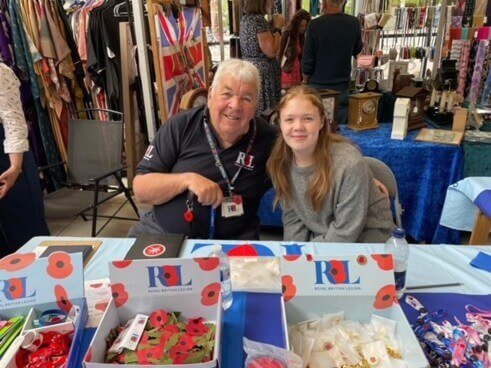
Remembrance is especially meaningful, it brings the whole community together to honour those who served and gave their all for this country. It’s also a time for veterans to remember friends who failed to come home. The level of support from local organisations, the police, the council, the various cadet units, the church and the public is always incredible. Everyone contributes to that particular day and brings it all together. Stewart is pictured here on a Poppy Appeal stall
|
|
|
What differences do you think volunteering makes to others/what do communities gain when volunteers step forward?
Volunteering is a really good way of getting to know people in the community, and often from wider communities as well. It really brings people together and ensures that important causes, like supporting veterans, continue to receive the attention and care they deserve. Why is volunteering important to you? How has volunteering benefitted you?
Volunteering gives me a sense of purpose and allows me to continue helping others after my professional career. It is very rewarding to know that you can make a difference in someone’s life. At the same time, it helps me stay connected to the community and meet a wide range of people.
What would you say to someone who is thinking about volunteering but not sure how to get involved or if they’ll be able to manage it? I would say just give it a try—even if it’s only for an hour. There’s no pressure, and every bit of help makes a difference.
We are always looking for more volunteers, especially during the Poppy Appeal, we never have enough collectors on the ground so please feel free to come and see us, you will be made very welcome, I’ll even buy you a cup of tea! What did being nominated and being runner-up at the Community Awards mean to you?
I was honoured and quite surprised to be named runner-up in the Over 60s Community Awards. I hadn’t expected it at all. It meant a great deal to know that others had recognised my efforts and taken the time to nominate me. I’m very grateful to everyone who supported me.
Anything else you’d like to share? Volunteering is incredibly rewarding, but we do need more people to get involved, particularly as many existing volunteers are older.
Even giving a small amount of time can make a big difference, and it’s a great way to meet people and support an important cause. The kindness and generosity of the Harborough community, especially during the Poppy Appeal, makes it all worthwhile.
If you would like to get involved in the Poppy Appeal or other volunteering with the RBL, you can contact Steward via details on their website.
|
|
|
| |
|
|
The HDC consultations webpage is regularly updated with any live consultations. There are no district-wide consultations at present, but Great Bowden Neighbourhood Plan Review is open until Wednesday 3 June 2026.
|
|
|
Accessing support in the armed forces community survey from Leicestershire County Council
Leicestershire County Council are running the 'Mission Ready' project across 2026, looking at strengthening support for the armed forces community, particularly those new to the area and relocating. They would like to hear views from people involved about how to focus some of this work and what people would benefit from most.
Are you an organisation or group that has members that are current or former members of the armed forces, who are the partner, spouse or family member of someone who is, or a member of the reserves?
Leicestershire County Council would like to hear people's thoughts to shape future work through their survey that groups can circulate to anyone relevant. The deadline for completion is 30 June 2026.
|
|
|
Funding and resources from other organisationsThis section contains a selection of grants outside HDC that community groups can apply for. |
|
|
While HDC provides grants for communities, groups often need to find further funding to complete projects. Here are some suggestions of other funders that have come across our radar that groups may be able to apply to. Inclusion does not imply that we endorse the funder, but we have spotted it and it seems applicable to the types of projects that we get enquiries about.
|
|
| |
With all grants, check the small print for exclusions such as types of organisations and annual turnover to ensure that you're eligible.
Grant fundraising is challenging at the moment, with many funders closing programmes early or completely, reviewing or narrowing programmes, and some moving to invitation only because of the volume of applications they're receiving, so make sure you sign up for email or social media alerts from the funder if applicable if you're making an application, and/or regularly check their website for changes.
It may also be worth searching for the funder on the Charity Commission website and downloading its annual report to see if you can find out more, or some funders report on 360Giving.
We would love to know if you have been successful applying to any of these to build up our knowledge of what funders are prioritising.
See our previous newsletters for other funding suggestions, while some are included in response to specific funding rounds, others are ongoing or will be reopening in the future.
|
|
|
This month's funding opportunities
Can I apply for funding for our volunteer programme?
How to frame funding applications to support volunteering
This is a question that volunteer-involving groups often ask. Many organisations rely on volunteers, and there is a cost to supporting and managing volunteers properly, and ensuring that they have resources necessary to undertake their roles. It's good practice to pay volunteer expenses for example for travel and possibly for meals and some organisations reimburse childcare and other caring responsibilities (highlighted in the section above about removing barriers to volunteering). |
|
|
When seeking funding for volunteer programmes, it’s important to frame your request around the outcomes and impact volunteers will deliver, rather than focusing solely on the costs of running the programme. Funders are typically motivated by the difference their contribution will make such as improved wellbeing, increased community cohesion, or enhanced local services, so your request should clearly link volunteer activity to these tangible results.
|
|
|
This means describing how volunteers will contribute to specific, measurable outcomes and then demonstrating what resources are required to deliver that impact, including coordination, training, and support costs. By positioning volunteer expenses as essential enablers of meaningful change, rather than standalone costs, you create a stronger, more compelling case that aligns with funders’ priorities and makes it easier for them to see the value of investing.
Some examples of how to pitch volunteering projects - more detail will be required tailored to each funder's questions and priorities, but this should give you an idea about the types of outcomes and impact that funders are looking for:
We are seeking funding to support a volunteer befriending programme that will reduce loneliness among older residents and help them remain independent for longer. Trained volunteers will provide regular social contact, wellbeing checks and signposting, contributing to improved mental health and a reduction in avoidable GP visits and social care interventions. Funding will enable the recruitment, training and coordination of volunteers who will collectively deliver over X hours of support and reach X residents annually. We are seeking funding to support a volunteer-led mentoring programme for young people at risk of disengagement from education. Volunteers will provide consistent one-to-one support, helping build confidence, resilience and aspirations. The programme aims to improve school attendance, reduce exclusion, and support positive transitions into further education or employment. Funding will ensure volunteers are safely recruited, trained and supported to deliver sustained, high-quality mentoring relationships. We are seeking funding to expand a volunteer-led environmental action programme that will improve local green spaces and increase community stewardship. Volunteers will deliver regular litter-picking, habitat restoration and community engagement activities, contributing to increased biodiversity and improved public use of outdoor spaces. Funding will support coordination, equipment and training to enable volunteers to deliver X improvement sessions and engage X residents, resulting in cleaner, safer and more sustainable local environments.
If you would like further support around applying for funding, please get in touch and tell us what would be useful. As well as our regular webinars around our grants, we have also run one about demonstrating outcomes and impact, which we could rerun, and we have delivered a further session for HDC staff about how to search for grants, which we could also adapt for a more general audience - let us know. |
|
|
Funding opportunities that could support projects delivered by volunteersThe opportunities shared below represent an illustration of funding programmes where eligible costs could cover volunteer support, training, equipment and activities.
Cellnex Community Fund Grants of up to £5,000.
Funding for community projects across the UK that empower people, improve local environments and promote digital and technological inclusion. Supports projects focused on digital skills, biodiversity and conservation, circular economy initiatives and AI or STEM education. Particularly suited to community-based projects that build confidence, encourage participation and strengthen local resilience.
Applicant organisations may include registered charities, CIOs, CICs, not-for-profit organisations and eligible community groups working through an accountable body. Applications are currently open
Grants | Esmée Fairbairn Foundation Grants of discretionary amounts.
Funding for organisations delivering legally charitable work in the UK that supports the Foundation’s priorities of improving the natural world, securing a fairer future and strengthening communities. Supports unrestricted, core and project funding, with most grants awarded over three to five years.
Particularly suited to organisations delivering long-term change, community-led work and projects tackling inequality or supporting community resilience - among the criteria they use to assess applications they include: the work is ambitious and/or doing something new to create systemic change; there is potential for wider influence or spread; Their work centres lived experience, justice and equity; they take a collaborative approach; our support could make a significant difference. Note from editor: if you have a project of this nature, we would be interested in talking to you, as taking a systemic approach, including involving public services is beneficial for Esmée Fairbairn.
Applicant organisations must be properly constituted charities or organisations undertaking legally charitable work in the UK with an annual turnover of at least £100,000. Applications are accepted on a rolling basis through a multi-stage process including an eligibility quiz and expression of interest.
The National Lottery Community Fund - Awards for All England Grants of £300–£20,000.
Funding for projects that bring people together and improve communities. Supports new or existing activities, community spaces and early intervention projects that help people reach their potential or respond to local challenges such as the cost-of-living crisis. Funding can cover a wide range of costs including staff, equipment and small capital works. Applications are open on a rolling basis.
Parkinson’s UK – Grants for physical activity providers Grants of £500–£3,000.
Funding for organisations, activity providers and community groups across the UK to develop new physical activity opportunities for people living with Parkinson’s. Supports projects that help people become and stay active, particularly those who are currently inactive or face additional barriers to participation. Funding can support equipment, venue hire, coaching costs, volunteer training and activity delivery.
Particularly suited to projects that encourage confidence-building, social connection and ongoing participation through movement-based activities, including sport, gardening, dance, music and creative activities. Applicant organisations must be based in the UK and demonstrate clear community need and appropriate safeguarding, insurance and governance arrangements.
Applications are accepted on a rolling basis until funding is fully allocated Focus Foundation - Grant FAQ's
Grants of typically £2,000–£8,000 are available for tangible projects (not core costs or part funding) that deliver clear, measurable benefits under one of three pillars: Social or Economically Disadvantaged Children, Mental Health or Community Projects.
Applicant organisations must be charities or community groups with annual income under £1m and core running costs below 35% and should apply via the online portal with an initial Expression of Interest followed by a full application if invited.
Deadlines: The Grants Committee meets four times a year the next dates are, 7 Sep 2026 and December) applications usually need to be submitted around 4 weeks before the relevant meeting, though the portal may close temporarily if the demand is high.
YAPP Charitable Trust - grant funding The Yapp Charitable Trust makes grants to small charities (not CIC's) in England and Wales to help sustain their existing work. Work must fit into the Trust's priority areas:
Elderly people. Children and young people. People with physical impairments, learning difficulties or mental health challenges. Social welfare – people trying to overcome life-limiting problems of a social, rather than medical, origin such as addiction, relationship difficulties, abuse, offending. Education and learning, with a particular interest in people who are educationally disadvantaged, whether adults or children.
Grants are normally for a maximum of £3,000 per year for up to three years. Most of the grants are for more than one year because the trust likes to fund ongoing needs. Grants are awarded for core funding, which is defined as the costs associated with regular activities or services that have been ongoing for at least a year.
Applications may be submitted at any time and are considered at one of the three trustee meetings each year. Decisions on applications can take up to five months from the date of submission. Applications should be submitted using the Trust's online application form.
Austin and Hope Pilkington Trust - grant funding Grants are available to registered UK charities for projects that address the Trust’s themed funding priorities on a rotating basis.
This fund is likely to be particularly relevant to mental wellbeing and community support projects in the upcoming rounds:
Round 3 and Round 4 – Unpaid Carers- Opening 1 July 2026 Funding will support projects that provide therapeutic support, including healthy eating and outdoor activities. Projects must focus exclusively on unpaid carers. 2027 Round 1 and Round 2 – Reducing Loneliness for 60s and Over Support for projects focused on reducing loneliness among older people. 2027 Round 3 and Round 4 – Mental Health for Young Carers Support for projects focused on improving mental health outcomes for young carers. Grants are awarded at either £1,000 or £5,000, depending on the round and charity income level.
Applicant organisations must be UK registered charities (or exempt charities) with a minimum income of £100,000. CICs, social enterprises and unregistered groups are not eligible. Applications open during each round window throughout the year. Organisations may submit one application per calendar year.
Allen Lane Foundation - grant funding The Foundation makes grants to voluntary not-for-profit organisations in the UK for work which benefits groups of people who are under-represented in UK society.
Overall, the Foundation wishes to fund work which: - Will make a lasting difference to people's lives rather than simply alleviating the symptoms or current problems.
- Is aimed at reducing isolation, stigma and discrimination.
- Encourages or enables unpopular groups to share in the life of the whole community.
The Foundation typically makes around 130 to 150 grants in a year with a total value of between £720,000 and £800,000. The average grant is £5,000 - £6,000 with a maximum grant of £15,000. This can be a single grant, or over two to three years.
The Foundation aims to help organisations to become sustainable. The funding will support running and core costs to enable them to have flexibility, security and longevity.
Applications can be made at any time and are considered three times a year, generally in February, June and October. Processing an application and making a grant usually takes between two and six months. Groups should apply as soon as they are ready as applications are processed ‘all the time’.
The Foundation has an online application system. The first step is to go through the online eligibility quiz. Those who are eligible will be directed to the application form.
For more information: Applying for funding – The Allen Lane Foundation J. Reginald Corah Foundation Fund
Grants of up to £2,000.
Funding for small charities and community organisations in Leicester, Leicestershire and Rutland. Supports a broad range of activities including youth initiatives, education, welfare and projects addressing identified local need. Particularly suited to smaller, locally focused projects. Applications accepted year-round. Email: jrcfoundationfund@gmail.com
Garfield Weston Foundation - Home Grants of up to £100,000 (regular) and £100,000+ (major grants)
Funding for UK registered charities across sectors including youth, community, education and health. Supports capital, project and core costs, with a focus on organisations delivering strong, sustained impact. Grants typically contribute 10–20% of total project costs and require match funding. Applications are open on a rolling basis.
Severn Trent - Community Fund Grants of £2,000–£20,000 and £20,001–£50,000
Funding for projects that support community wellbeing under three themes: People, Place and Environment. Supports a wide range of initiatives including community spaces, environmental improvements and projects that build skills and resilience. Deadlines: 2 August 2026 (£20k–£50k) and 31 August 2026 (£2k–£20k). Other current funding opportunities for communities
The Office of the Police and Crime Commissioner for Leicester, Leicestershire and Rutland - Community Action Funding
There are three further rounds with varying opening and closing dates: - Neighbourhood Crime - 28 September 2026
- Buisness Crime - 8 February 2027
Eligible groups can apply for grants up to £10,000 to support their initiatives. |
|
|
Getting further support
See the community engagement team website to download a document about the support available to various voluntary and community groups across the district. Let us know if there's anything else you think we could include.
The page also includes case studies about projects that have received Community Grant funding to share ideas and good practice with others. |
|
|
|
Previous newslettersSee previous editions of our newsletter for good practice resources and funding suggestions. |
|
|
|
|
|
|
|
|
|
|