The powerful vibrations bees use to collect pollen from flowers come at a surprisingly high energy cost, shedding new light on the hidden challenges of pollination, according to new University of Sussex-led research.
The study, released by The Royal Society on World Bee Day (20 May), shares the first direct measurement of the energy required for “floral buzzing” – a behaviour used by many bees to shake pollen loose from flowers, including crops such as tomatoes and blueberries. |
|
|
Scientists at Sussex and Uppsala University in Sweden used specialised lasers to simultaneously measure both the vibrations produced by buff-tailed bumblebees (Bombus terrestris) and their carbon dioxide production.
The team found that bees’ floral buzzing requires roughly the same amount of energy as flight take-off. Because buzzing bouts often last much longer than take-off, total energy exertion is likely to be much greater.
When flowers produce less sugary nectar, bees need to visit more flowers to replace the energy lost during buzzing.
Research lead and Sussex Research Fellow Dr Natacha Rossi says: “As nectar availability shifts due to climate change or habitat loss, the energetic demands of pollination could influence bee behaviour and, ultimately, where bees forage and which plants they pollinate.” |
|
|
Sussex project explores early signs of infant development |
|
|

| Watch episode one of the Baby Grow project |
|
Could the way babies wriggle, kick and stretch in their first months of life help scientists spot early signs of neurodevelopmental conditions?
The Baby Grow project, led by Professor Gillian Forrester at the University of Sussex, has been tracking babies’ development since 2023. More than 100 families are taking part, helping researchers explore how infants’ earliest movements are linked to later social and communication development.
|
|
|
The project is monitoring babies for the first 30 months of their lives, aiming to reveal new, evidence-based ways to assess early development and support earlier detection of conditions such as autism.
For the first eight months of the project, parents filmed their babies at home from the same angle, with each baby wearing a onesie and lying on a yoga mat. Some babies also wore “intelligent onesies” with embedded motion sensors to measure the direction and speed of arm and leg activity. Researchers use this data alongside AI software to analyse tiny movements, from twitches and fidgets to kicks and stretches.
The first Baby Grow project documentary and podcast episode has now been released, sharing how the study is being carried out and introducing some of the families taking part.
Professor Forrester, who was invited to join a round table at the House of Lords on 22 April about early intervention for children with a high likelihood of having autism, said: “We’re only just beginning to understand how motor and sensory behaviours in the first days of life influence later social and communication ability. This provides earlier opportunities for novel interventions to support healthy cognitive development – when brain development is at its most flexible.”
Watch episode one of the Baby Grow project and listen to the podcast |
|
|
How does the brain create our experience of reality? |
|
|
|
|
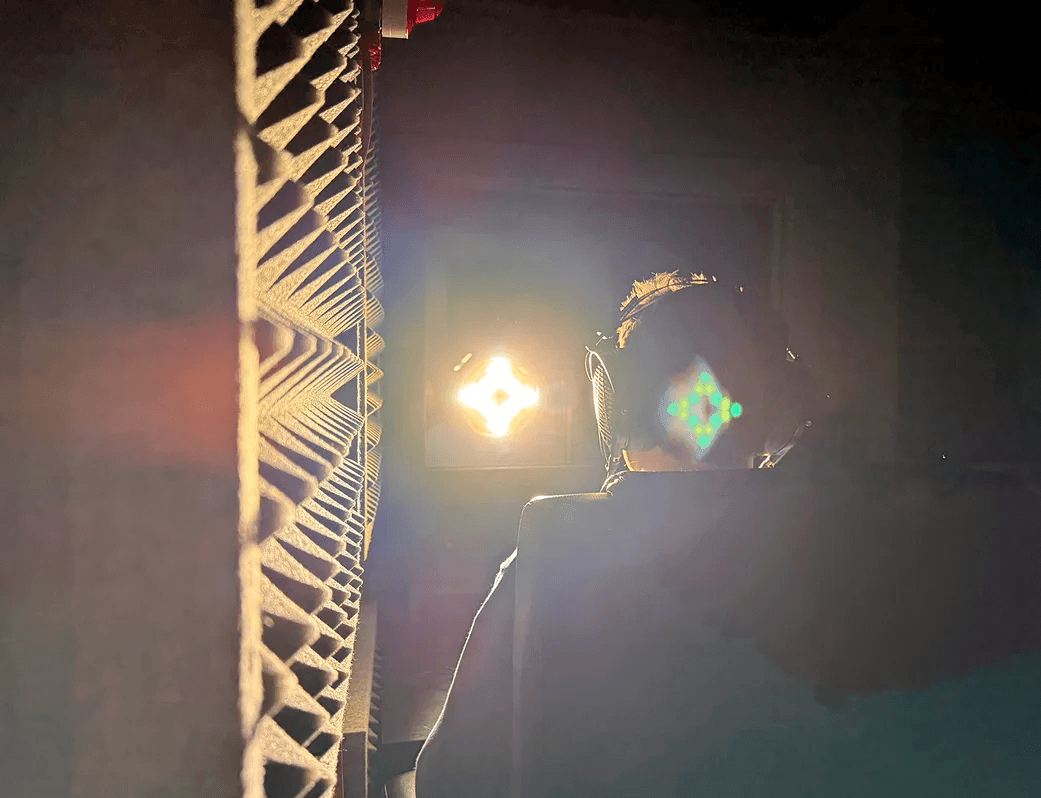
The technique, known as stroboscopic light stimulation, uses rhythmic flashes of light to drive activity in the visual system, including the visual cortex, the part of the brain that processes what we see. As Dr Schwartzman explains: “In some sense, stroboscopic hallucinations reflect the brain momentarily seeing itself.” The spirals, grids, and waves of colour people experience are not images from the outside world but are thought to be internally generated patterns shaped by the structure and dynamics of the visual cortex.
Rather than simply recording the world around us, the brain is constantly making predictions and using sensory information to update them. Stroboscopic stimulation offers researchers a controlled way to explore this process and to study how the brain generates conscious experience.
The research may also have therapeutic potential. Dr Schwartzman’s Medical Research Council-funded work is investigating whether supervised stroboscopic-light sessions can be used safely for people with depressive symptoms, while also exploring effects on mood. Early findings are described as encouraging, but larger studies will be needed before clinical claims can be made.
Read the full BBC Science Focus article to find out more. |
|
|
|